Pregnancy
MARRIED TO MY MASTER: A Bad Boy Hitman RomancePregnancy is a recurring plot state whose significance varies sharply across the book’s storylines: it can be a frightening discovery, the aftermath of a loss, a secret that reshapes a relationship, or a goal another person tries to impose. The excerpts do not present these situations as one continuous family history. Instead, they use pregnancy to make intimate relationships carry consequences beyond the couple, while repeatedly placing questions of parenthood alongside danger, secrecy, and limited control.
Meaning and Narrative Function
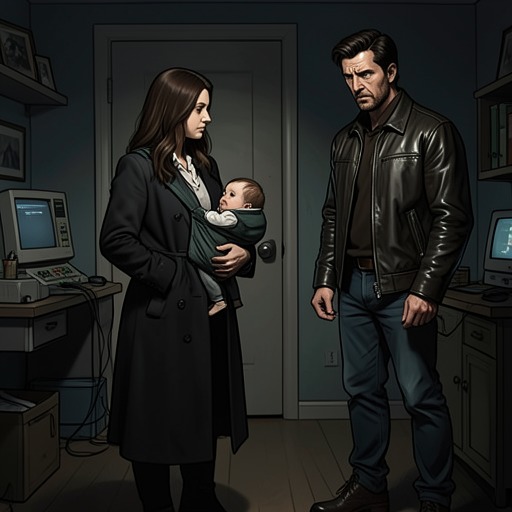
Pregnancy often changes the scale of a conflict. In several story premises, the possibility or fact of a child makes a private relationship consequential to someone beyond the adults involved. One account describes a pregnant woman as having put both herself and a baby in danger while facing a dangerous man she barely knows and killers who threaten them. Another turns pregnancy into a revelation of concealed parenthood: Misha appears on a doorstep with a baby in her arms, and the person who calls the child his is left reeling. In these cases, pregnancy and the child’s existence alter what characters understand about their relationships and what they stand to lose.
The excerpts distinguish a confirmed pregnancy from a plan, demand, or fear. Some narrators state that they are already pregnant; others describe a man who intends to get them pregnant, or present submission to pregnancy as a choice made under coercive circumstances. That distinction matters: a hoped-for baby, an unexpected test result, and a pregnancy used to control someone are not equivalent states, even when the surrounding plots all use future parenthood as a source of suspense.
Ana’s Discovery and the Burden of a Past Loss
Ana’s storyline supplies the clearest sequence from suspicion to confirmation. After she and Grizzly have had unprotected sex, she notices that her period is late. Because her cycle is normally regular, the delay immediately unsettles her. She has avoided taking a test, in part because a result would make the possibility difficult to keep at a distance while she is already trying to manage other pressures. She also remembers that she once wanted to become a mother and had nearly done so before an earlier loss changed what she believed possible for herself.
Eventually, Ana lets Kid take her to a convenience store, giving him a stomach bug as an explanation for the errand. She goes into the store alone and buys every brand of pregnancy test it carries. Each test is positive. In the privacy of the bathroom, the results confirm that she is pregnant, and the prospect that Grizzly will become a father becomes immediate rather than hypothetical. The sequence makes the tests themselves important: Ana’s attempt to contain uncertainty ends not with one ambiguous result but with repeated confirmation.
That discovery sits alongside a pregnancy she had never disclosed. When she finally tells Grizzly about the earlier baby, she says the pregnancy preceded the raid and that she lost it after Rodent died. She has kept the loss as a private secret for years and explains that she could not remain at the clubhouse after what happened. The confession changes what Grizzly knows about Ana’s departure: leaving was connected not only to the immediate violence and upheaval, but also to a bereavement she had been carrying without telling him.
A separate confrontation with Rodent adds a contested understanding of that earlier pregnancy. Rodent says he saw the test and had waited for Ana to tell him, believing the baby was Grizzly’s after Ana was carried away from him. Ana responds that the baby was Rodent’s and that she had not slept with Grizzly while she was with Rodent. His reaction frames the pregnancy as evidence of suspected betrayal, while her disclosure identifies fear as the reason she kept it secret. The excerpts do not make every aspect of the pregnancy’s timing and paternity transparent; they do make clear that different characters attach sharply different meanings to the test and that Ana’s own account comes only under pressure.
Pregnancy Across the Story Premises
Other excerpts use pregnancy as a declared condition or a threatened future. One woman says that if Grizzly has his way, she will soon be pregnant with his child; a separate promotional passage announces a narrator already pregnant with Maverick’s baby. A related premise stresses that the narrator’s involvement with a murder suspect has put not only her own safety but also a baby she can barely protect at risk. Together, these passages move from anticipated pregnancy to confirmed pregnancy and then to the danger surrounding a child who depends on adults caught in a violent conflict.
The mobster-centered material likewise makes pregnancy a consequence that does not end when an encounter does. A narrator says she is pregnant with the mobster’s baby; another passage describes the mobster as having left something behind and coming back to claim it. The framing makes the pregnancy a continuing tie, while emphasizing his possessive intention rather than establishing a secure or freely chosen family arrangement. In the premise involving Rip, the demand is more explicit in its purpose: solving the narrator’s problem is linked to his wish to possess her and use her to carry his child. Another blurb presents submission and bearing a biker’s baby as the decision facing a woman caught in a charade. These are stated as coercive demands or pressured choices, not as evidence that a pregnancy has already occurred.
The excerpts also use pregnancy to expose concealed or disputed parenthood. In the story involving Misha, her arrival with the narrator’s baby reverses his understanding of his life in an instant. In the premise about Chopper, a woman says he kidnapped her and fathered her baby, while a related passage says that learning of her pregnancy closes off what she saw as her remaining opportunities to escape. The Spike Lawler material makes a different distinction: the pregnant woman is described as his old lady, but the baby is said not to be his. Here pregnancy becomes a vulnerability that can be used against a man through a secret he does not know, as well as a condition that may tighten a captive woman’s confinement when he discovers it.
Reproductive Choice, Secrecy, and Consequence
Across these situations, the central contrast is between pregnancy as a person’s experience and pregnancy as someone else’s objective. Ana delays testing because confirmation would force her to face a possibility shaped by prior loss; she later chooses to disclose that loss to Grizzly, but only after years of silence. Other premises place women in relationships with dangerous or possessive men, where pregnancy is treated as a claim, a demand, or a means of narrowing the possibility of escape. The recurring state therefore does more than signal a future child: it reveals who can make decisions, who controls information, and how much safety surrounds the prospect of parenthood.
The consequences also extend beyond the moment of discovery. Ana’s tests establish a present pregnancy, while her later confession describes an earlier one lost amid events surrounding the raid. Misha’s return with a baby makes parenthood a fact that another character must suddenly absorb. In the coercive premises, by contrast, a man’s stated wish for a child does not establish that a woman is pregnant or that she has consented to that future. By keeping these outcomes distinct, the excerpts make pregnancy a varied and unstable narrative hinge: confirmation can transform uncertainty into knowledge, a hidden child can overturn a relationship, and the threat of forced parenthood can turn intimacy into a struggle over safety and autonomy.